
Calgary’s condo market is having the correction that several people, including me, said was coming. It is worth looking at plainly, because the coverage tends to swing between “the sky is falling” and “now is a great time to buy,” and neither is a useful description of what the data says. Here is where things actually stand, and what I think it means depending on which side of it you are standing on.
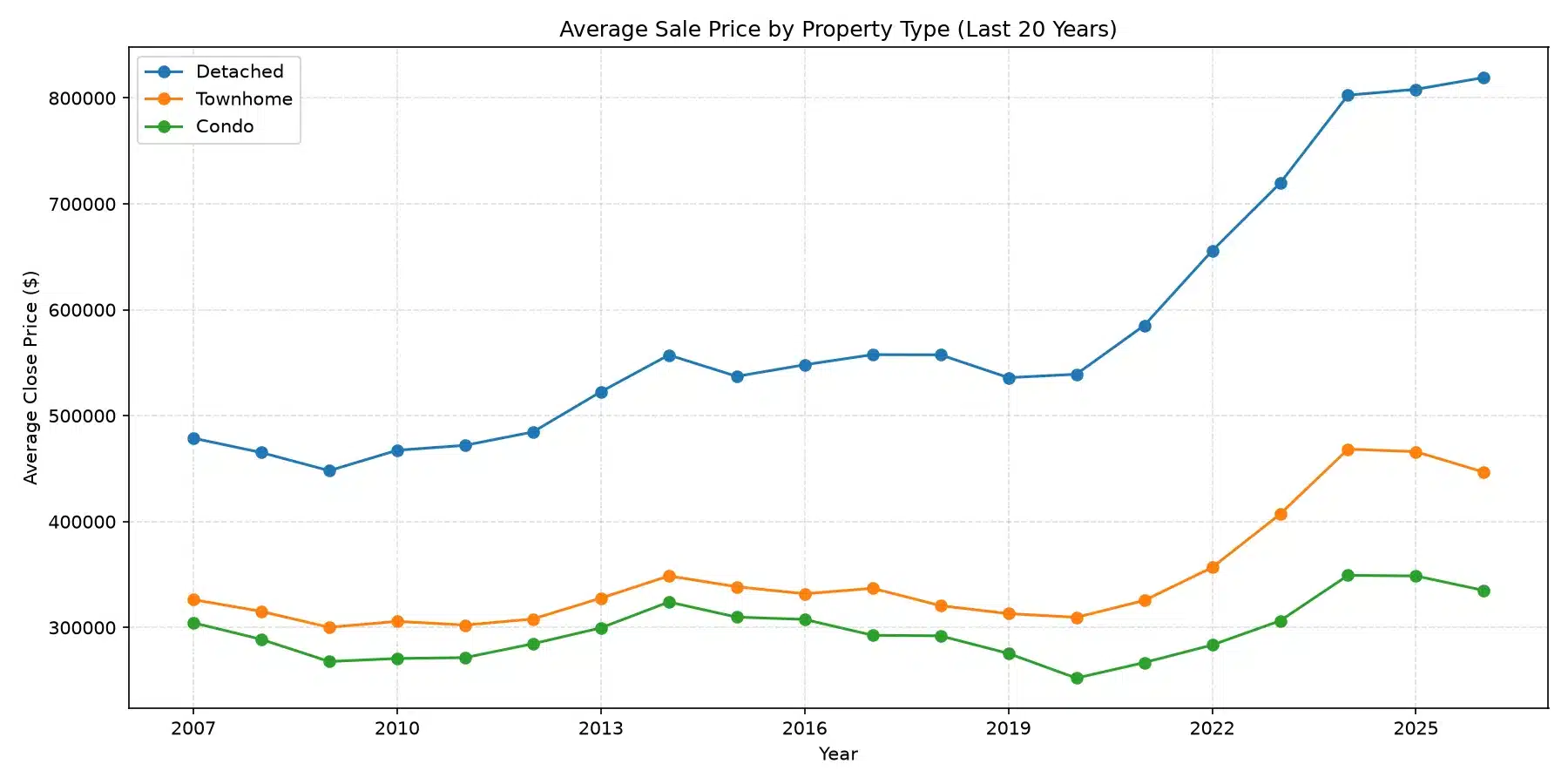
The Numbers, Without Commentary
From CREB’s August 2026 release:
- Apartment condominium benchmark price: $295,400, down over 8% year over year.
- Months of supply in the apartment segment: around six.
- Year-to-date apartment sales: down 26%.
- Row / townhouse benchmark: $415,200, down about 5%, roughly four months of supply.
- Detached benchmark, for contrast: $744,300, down about 1%.
- City-wide inventory: 6,509 units, with 1,660 sales in the month.
And the number that explains the rest of them, from CREB’s July release: more than 17,000 apartment-style units under construction, arriving alongside reduced international migration.
Why This Was Predictable
Condo supply behaves differently from detached supply, and understanding that difference explains most of what you are watching.
To add fifty detached homes to an established Calgary community, someone has to find fifty lots. In Acadia, in Haysboro, in Southwood, those lots do not exist — the community was built out decades ago. Supply in that segment is functionally fixed, which is why prices there are sticky in both directions.
To add five hundred apartment units, a developer needs one parcel of land and an elevator. Supply in the apartment segment is not fixed at all. It is manufactured, on a two-to-four-year delay, based on demand conditions that existed when the shovels went in the ground.
That delay is the entire story. The towers completing in Calgary right now were financed and started when population growth was running hot and everyone assumed it would continue. The demand assumption changed. The concrete did not.
This is the mechanism I described in Think Twice Before Buying a Calgary Condo as an Investment: supply that can flood in overnight is a structural feature of the asset class, not a one-off event. It has happened in Calgary before and it will happen again.
What Six Months of Supply Means in Practice
Months of supply is the most useful single number in real estate and most people have never had it explained. It answers one question: at the current pace of sales, how long would it take to sell every unit currently listed, assuming nothing new came on the market?
- Under 2 months — seller’s market. Multiple offers, homes selling above list.
- 2 to 4 months — roughly balanced.
- Over 4 months — buyer’s market. Price reductions, longer days on market, conditions being accepted.
Calgary’s apartment segment at around six months is not marginally soft. It is a clear buyer’s market, and the detached segment at just over three months is not — which is why a single “Calgary market” headline is almost always misleading. I wrote a short guide to reading these reports properly because this one number tells a seller more than any forecast will.
If You Own a Calgary Condo
First, the thing nobody says out loud: if you are living in it and not selling, none of this costs you anything today. Paper losses are only losses when you crystalize them. A benchmark number is not a withdrawal from your account.
If you do need to sell, a few things are true and worth accepting quickly rather than slowly:
Your competition is new construction, and it does not blink
A developer with unsold inventory has carrying costs, lender covenants and a completion schedule. They will offer incentives, cover fees, throw in parking and hold their headline price so the whole building does not reprice. You are competing against that, and against every other resale owner in your tower.
Price cuts in a falling market chase the market down
This is the most expensive mistake I watch owners make. List high, sit, cut a little, sit, cut a little more. Each cut lands slightly behind where the market has already moved, and the listing accumulates days on market — which buyers read as a signal that something is wrong with it.
A new listing has a short, real window of attention from every buyer already searching that segment. I have written about why that advantage vanishes fast. In a six-month-supply market it is close to the only advantage you get, and pricing to be found in week one is worth far more than pricing to leave negotiating room.
It is probably not your Realtor’s fault
I wrote a whole piece on whether you should fire your Realtor when your condo has not sold, and the August numbers make the point better than I did. Year-to-date apartment sales are down 26%. When a quarter of the buyers leave a segment, the listings that remain take longer. That is arithmetic, not effort.
If You Are Thinking About Buying One
I am not going to tell you never to buy a condo. I am going to tell you the three questions that separate the ones that work from the ones that quietly cost people money for a decade.
1. How long will you hold it?
Those 17,000 units are not finished arriving. Buying into a segment with six months of supply and a visible construction pipeline means accepting that the next few years may not be kind. On a ten-year horizon that matters much less. On a three-year horizon it is the whole game.
2. What do the condo documents say?
This is where the real money is won and lost, and it has nothing to do with the market. An underfunded reserve fund in a 1978 building with original windows and a failing envelope will cost you more in one special assessment than eight percent of market movement. Read the minutes, read the reserve fund study, read the financials — here is how to do that without losing sleep, and here is what the fees are actually paying for.
A building charging $700 a month and funding its reserve honestly is cheaper over ten years than one charging $400 and deferring everything.
3. Are you buying the unit or the land under it?
Your share of the land in a 200-unit tower is a rounding error. What you own is essentially a box of air with an obligation attached. That is fine if the box does what you need — location, lock-and-leave, a price you could not otherwise reach — but it is a different asset from a detached home, and it should not be valued using the same instincts. That is the core of why older detached homes quietly outperform.
The Genuine Opportunity In This
I said I would not pretend this is all bad, so here is the part that is real.
A market with six months of supply is a market where buyers can do things that were impossible in 2022. Conditions on financing and inspection get accepted. Sellers respond to offers below list. Nobody is asking you to waive the condo document review — which, in that market, people genuinely did, and some of them are still paying for it.
More specifically: a correction driven by new supply tends to price the whole segment as one thing, and it is not one thing. Well-run buildings in established inner communities with healthy reserves are being marked down alongside the oversupplied new towers they have nothing to do with. That is the inefficiency worth hunting.
Finding it means comparing a specific listing against what similar units in that specific building and community actually sold for, rather than against a city-wide benchmark. That is exactly what my Deal Finder does, and it updates daily across more than 100 Calgary communities.
What I Think Happens Next
I will be careful here, because anyone giving you a confident price forecast is selling something.
What I can say is mechanical rather than predictive. Those 17,000 units will complete on a schedule that is already set. Until that pipeline clears and absorption catches up, the apartment segment has a supply overhang that does not care about sentiment. Meanwhile detached supply cannot expand the same way, which is why detached is down about 1% while apartments are down over 8% in the same city, in the same month, under the same interest rates.
That divergence is the most important thing in the Calgary market right now, and it is invisible if you only read the city-wide number.
If you own a condo and want to know what your specific building has actually been selling for — not the benchmark, your building — send me the address. I will pull the sales history and send it back. No pitch attached.
Jerry Charlton — eXp Realty — 403 831 0842 — Jerry@JerryCharlton.com
Frequently Asked Questions
Are Calgary condo prices falling in 2026?
Yes. CREB’s August 2026 figures put the apartment condominium benchmark at $295,400, down over 8% year over year, with year-to-date sales down 26%. By contrast the detached benchmark was $744,300, down only about 1% in the same month.
Why is the Calgary condo market oversupplied?
More than 17,000 apartment-style units are under construction, financed when population growth was running hot, arriving now that international migration has slowed. Apartment supply can be manufactured on a two-to-four-year delay, unlike detached supply in built-out communities.
What does six months of supply mean for Calgary condos?
It means that at the current sales pace it would take about six months to sell every listed apartment unit with nothing new added. Under two months is a seller’s market, two to four is balanced, and over four is a buyer’s market — so six months gives buyers meaningful leverage.
Is now a good time to buy a Calgary condo?
It depends on your holding period. On a horizon under about seven years, the construction pipeline and six months of supply argue against it. On a ten-year horizon, with a well-run building and an honestly funded reserve, the current buyer’s market offers conditions and negotiating room that were unavailable in 2022.
Why are Calgary detached homes holding value while condos fall?
Supply. Established Calgary communities have no vacant lots, so detached supply is effectively fixed and prices are sticky in both directions. Apartment supply is manufactured and can arrive in volume regardless of current demand, which is why the two segments moved 1% and 8% in opposite directions in the same month.
Leave a Reply