Most investors spend their energy worrying about where the market is going: interest rates, headlines, forecasts, booms and busts. All of it matters. None of it matters as much as the one variable you actually control: where you start from.
Two investors can buy in the same year, on the same street, in the same market, and one will quietly outperform the other for twenty years. Not because of timing. Because of entry price. Here’s why buying below market value changes everything that follows, and where those buys actually come from in Calgary.
The $1 Problem Most Investors Never See
Imagine every investor starts with exactly one dollar. Everything that happens next comes from three things:
- What they bought: the asset itself.
- How they financed it: leverage.
- What it did while they owned it: appreciation, mortgage paydown and cash flow.
Most people assume the market does the heavy lifting. In reality, your starting position quietly amplifies or weakens every return that comes after it.
Buy something worth $1.25 for $1.00, and the market barely has to move for you to win. Buy that same asset at full retail or above, and you need years of appreciation just to catch up to the investor who started with an edge. The market didn’t make that difference. The purchase did.
The Three Moments Real Estate Wealth Is Created
1. When You Buy
Buying below true market value doesn’t just get you a deal. It changes your whole return curve. You carry less downside, you have more safety and you have more room to borrow later.
- If the market does nothing, you still win.
- If the market rises slowly, you win faster.
- If the market rises strongly, you compound on a larger base.
That’s why experienced investors obsess over entry price, and new investors obsess over timing.
2. While You Hold
Once you own it, three things work for you every month. The land appreciates. The tenant pays down your mortgage. Cash flow, if there is any, feeds you along the way.
Leverage magnifies all three. With 20% down you control 100% of the asset and collect 100% of the gains. That works best when the asset underneath is scarce and hard to reproduce, which is why I favour detached homes in older Calgary communities. But even perfect leverage can’t fix a weak starting position.
3. When You Exit
The investor who bought with a margin of safety can sell in a good market without stress and in a bad one without panic. Their equity cushion gives them options. The investor who paid full retail often becomes a hostage to timing, because they can’t exit without losing equity they never had in the first place.
The difference between those two outcomes was decided years earlier, on purchase day.
What That Extra 25 Cents Really Does
Buying $1.25 of value for $1.00 doesn’t leave a windfall sitting in the corner. That extra 25 cents works through the whole investment:
- More equity on day one
- A lower loan-to-value, which improves your refinancing power
- A bigger cushion if rents drop or rates rise
- More freedom to choose when you sell
Most importantly, it lets you survive mistakes that sink buyers who paid full price. That’s why seasoned investors say you make your money when you buy, not when you sell.
Where Below-Market Buys Actually Come From
Here’s the honest part: you rarely find a $1.25 home listed at $1.00 with a sign on it. The discount usually comes from something other buyers walk away from:
- Condition: dated, tired or needing work that’s cosmetic rather than structural. The Flip Finder shows where the gap between original and renovated homes is widest.
- Pricing: listings priced below recent sales of similar homes nearby. The Deal Finder flags these.
- Time on market: a stale listing often means a seller who’s ready to talk.
- Motivated sellers: estates, relocations and foreclosures. I cover the last one in stop chasing foreclosures, start finding deals.
- Negotiation: the same house can sell for very different prices depending on who’s at the table. That’s the negotiation edge.
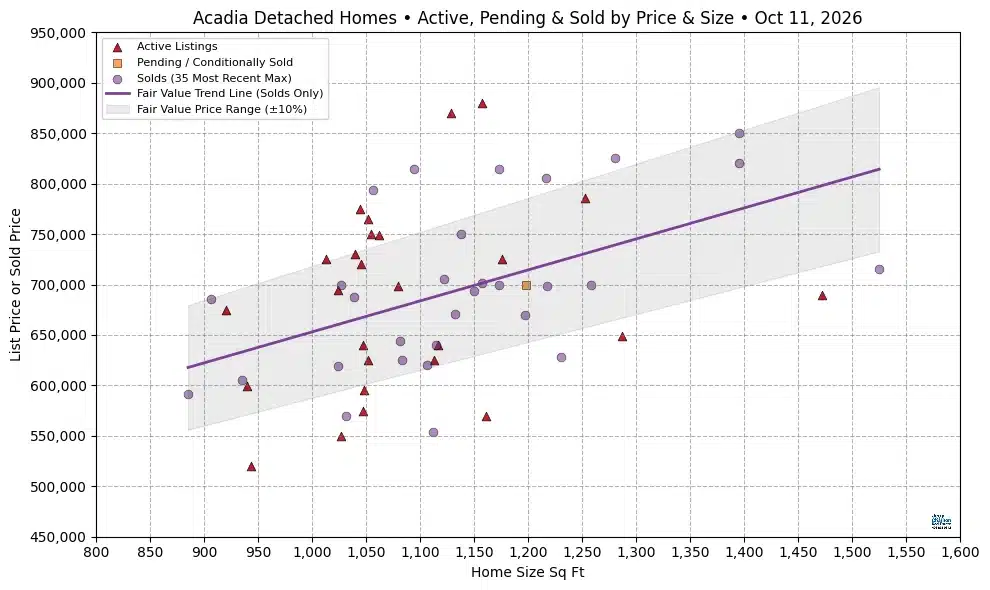
To know whether a price is really below value, compare it to what similar homes in that community actually sold for. That’s what my fair market value charts show.
Why Older Calgary Communities Reward a Good Entry
A good entry works best where land is already scarce. In older Calgary communities like Acadia, Fairview, Haysboro, Kingsland and Southwood, the supply is fixed. Nobody is making more lots there.
Over time, the land does most of the work and the house matters less. A below-market purchase in one of these communities rides on an asset that keeps getting scarcer. Condos are different: another building can go up down the street. You can reproduce a condo. You can’t reproduce a neighbourhood.
Entry Price Beats Market Timing
Markets move up and down. Your entry price is set once and stays with you for as long as you own the property.
- A good purchase survives bad markets.
- A bad purchase needs perfect markets.
- A great purchase does well in almost any market.
Long-term success rarely belongs to the person who timed the bottom. It belongs to the person who bought with discipline, a margin of safety and a clear idea of what the property was really worth.
My Role in This Equation
I don’t control interest rates, immigration, construction or the broader market. What I can help with, and what affects your outcome for decades, is how you enter the investment: finding the right property, knowing what it’s really worth and negotiating the price.
The market compounds what you buy. I help you decide where you begin.
The market controls how fast your money grows. Your purchase price controls where it starts.
Want to Start From a Better Place?
I’ve been a Calgary Realtor® since 2002, and I’m an investor and landlord myself. Get alerts on under-value Calgary homes before anyone else, or call me and we’ll talk through what you’re looking for.
Jerry Charlton, eXp Realty
📞 403 831 0842 | jerry@jerrycharlton.com