
Real Estate Investing: Why I’d Encourage a Young Calgarian to Work Toward Owning a Detached Home
If you’re 18 and living in Calgary, buying a house might seem like something you’ll worry about much later.
You may be finishing school, starting an apprenticeship, looking for your first full-time job, or wondering how anyone pays rent and still saves money.
You don’t need to buy a property tomorrow. But understanding what you’re eventually buying can change the decisions you make today.
My preference is straightforward: rent a condo or townhome while you build your finances, and work toward buying a detached home as soon as you can responsibly afford to own it.
These two charts help explain why I favour that approach. They also show why patience, financial stability, and the ability to hold a property matter.
They tell a useful story about Calgary’s past. They cannot promise what happens next.
Imagine three young Calgarians buying their first homes in 2007.
One buys a detached house. Another buys a townhome. The third buys an apartment condo.
They all become homeowners. They all have mortgage payments, bills, and maintenance responsibilities. But the property categories they bought into follow different paths over the following years.
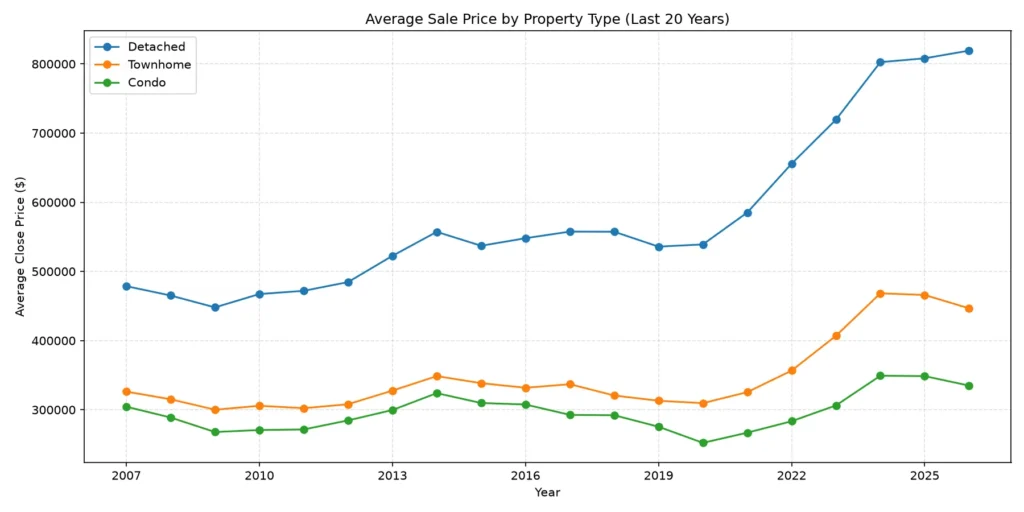
The first chart shows average sale prices. Reading the chart approximately:
| Property type | 2007 average | Latest 2026 point | Approximate increase |
|---|---|---|---|
| Detached | $479,000 | $820,000 | 71% |
| Townhome | $326,000 | $447,000 | 37% |
| Apartment condo | $304,000 | $334,000 | 10% |
These are rounded readings from the supplied charts. The 2026 point represents a partial year, not a completed calendar year.
Detached homes finish well ahead.
The second chart makes that difference easier to understand. It starts each category at zero per cent in 2007, then measures the percentage change in its average sale price.
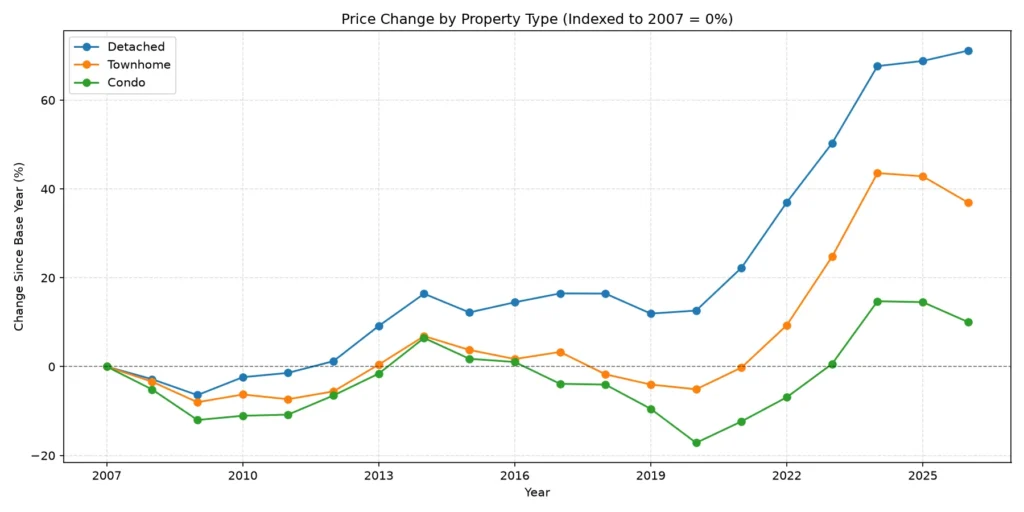
That removes the distraction of detached homes costing more at the beginning. Their lead is substantial in percentage terms as well as dollars.
But there’s a detail every young buyer needs to understand: these are averages of the properties sold each year. They are not repeated valuations of the same three homes.
If more large, expensive detached homes sell in one year, that can push the average up. Changes in neighbourhood, size, age, and condition also affect the numbers. CREB’s benchmark measures are designed to track a typical property more consistently than a simple average. CREB’s explanation of housing statistics
The supported conclusion is that detached average sale prices rose much more over this particular period. Your individual result would depend on what you bought, what you paid, and what happened to that property.
Now look at the middle of the charts.
The journey was nothing like a steady climb.
Detached average prices fell after 2007, recovered, and then spent years moving within a fairly narrow range. The chart puts the detached average around $558,000 in 2014 and around $540,000 in 2020.
Someone who bought in 2014 and needed to sell in 2020 could have had a very different experience from someone who stayed through the later increases.
The condo line is even more sobering. Around 2020, its average was roughly 17% below the 2007 starting point.
Thirteen years is a long time when you’re 18.
It’s enough time to finish your education, build a career, get married, have children, and change your plans several times.
That is why “real estate goes up over time” is an incomplete sentence. The purchase price, ownership costs, and date you need to sell all matter.
So why do I still favour detached ownership?
A major reason is the land.
When you buy a conventional detached home with its own lot, you’re buying a building and a particular piece of Calgary.
The building provides shelter. The land provides the location and whatever uses are legally and physically possible there.
The roof ages. The furnace wears out. Kitchens become dated. Foundations sometimes need work. Keeping a house useful requires money.
Meanwhile, the location may become more desirable. Jobs, transit, shops, parks, schools, and other services can change what people are willing to pay to live nearby.
Imagine an older bungalow on a useful lot in an established neighbourhood. Fifty years from now, the kitchen you see today may be gone. The entire bungalow might have been replaced.
The address will still occupy that location.
That is the part of detached ownership I want young buyers to understand. The long-term opportunity can extend beyond the life of the existing finishes or even the existing building.
Calgary’s assessment guidance identifies location, lot size, building characteristics, and other property features as factors affecting value. Its guidance for vacant residential land also emphasizes location. City of Calgary property assessment guidance
However, these two charts do not prove that land caused most of the detached price increase.
They don’t separate land values from building values. They don’t control for renovations, larger homes, construction costs, neighbourhood differences, or changes in the properties sold.
To measure land’s contribution properly, we would need additional evidence: comparable land sales, matched property histories, and analysis separating building changes from location and land value.
My preference for detached ownership is a judgment informed by the history and the ownership characteristics. It is not a causal fact established by these two lines.
There is another distinction worth getting right.
“Condo” describes a form of ownership. “Townhome” and “detached” describe building styles.
Condominiums can be apartments, townhomes, or even detached homes. Alberta condominium ownership includes ownership of the unit and an interest in common property; depending on the condominium plan, that common property can include land. Townhomes can also have different ownership structures. You need to examine the title and plan rather than assume the building’s appearance tells you what you own. Alberta’s explanation of condominium property
The useful distinction is often how much land interest and decision-making control come with your purchase.
With a conventional detached property, you generally have more direct control over your lot, subject to municipal rules and restrictions on title. With a condominium, important decisions about common property are shared.
Neither arrangement makes land automatically valuable. An overpriced lot in an undesirable location can be a poor purchase. A well-priced condominium can work well for its owner.
To understand Calgary housing, picture several groups making decisions at once.
People move here for work, family, education, and lifestyle. Some rent. Some buy. Existing residents form new households, separate, have children, or downsize.
Employers influence whether people can find work and earn enough to support housing costs.
Lenders influence how much buyers can borrow. Interest rates influence how much that borrowing costs.
Builders decide whether they can deliver housing at a price that covers land, labor, materials, financing, and profit.
The City influences development through planning, infrastructure, and approval decisions.
Owners decide whether to sell. Investors compare purchase prices with rents, expenses, and other places they could put their money.
These decisions interact. There is no single person setting “the Calgary price.”
If more households want homes than are available at prices they can afford, competition can push prices and rents upward. If construction adds supply while demand slows, buyers and tenants may gain more choice.
Calgary’s own housing research tracks population, construction, rents, and other measures because those forces must be considered together. City of Calgary housing trends
This also explains why different property types can move differently.
A household priced out of detached ownership may consider a townhome. Someone priced out of buying may continue renting. Developers may build more apartments when land and construction economics favour them.
Extra supply can relieve pressure in one segment without immediately solving shortages in another.
Calgary can add housing through both outward development and redevelopment. It is too simplistic to say, “They aren’t making any more land,” and stop thinking.
What cannot be reproduced is the exact location of an existing lot. But competing homes can still be built elsewhere, and more homes can sometimes be built on existing land.
Land value depends on demand, alternatives, permitted uses, and the cost of making those uses possible.
Now bring that back to your first housing decision.
Imagine you’ve started working and can afford to rent a modest apartment.
Someone tells you that rent is wasted money and you should buy anything you can get approved for.
I would slow that conversation down.
Rent buys a place to live. It also buys flexibility. That flexibility can be useful when your job, relationship, education, or preferred neighbourhood might change.
Owning has costs that do not become equity: mortgage interest, taxes, insurance, repairs, and transaction expenses.
Part of a mortgage payment reduces the loan balance. That part builds equity, assuming the property’s value holds. The interest portion pays for borrowing the money. Financial Consumer Agency of Canada mortgage guidance
Buying a condo for a short stay and then selling it to buy a townhome, followed by another sale to buy detached, can involve repeated expenses.
That does not mean the sequence always fails. It means you should calculate whether those steps help you reach your actual goal.
My preferred alternative is to rent suitable housing, keep your spending controlled, improve your earning power, and save deliberately toward the property you want to hold.
The word “deliberately” matters.
Renting only builds your purchasing power if you actually save the difference when renting costs less. Spending every available dollar while waiting for a detached house is not an investment strategy.
There is also a risk to waiting: detached prices could rise faster than your savings.
That is why my advice is a preference to evaluate, not a promise that renting first wins in every market.
Buying a well-managed condo or a suitable townhome can make sense when it provides affordable, stable housing for a long period. Someone may also value accessibility, location, or reduced maintenance responsibilities more than a detached lot.
The charts do not measure those benefits.
They also don’t show investment income.
A rental property’s outcome includes rent collected, vacancy, financing, repairs, management, taxes, and its eventual selling price. An apartment with weaker appreciation could still produce a better overall investment result than a detached house bought at an excessive price.
Likewise, an owner-occupied home provides somewhere to live. A fair comparison with renting includes that housing benefit and what the renter does with money not tied up in ownership.
Price appreciation is one part of the calculation.
Condo fees deserve the same practical treatment.
A fee may pay for services, insurance, maintenance, and contributions toward future common-property repairs. Alberta requires condominium corporations to maintain reserve funds for major repairs and replacement of common property. Alberta condominium reserve fund guidance
A detached owner still has repair costs. They simply arrive through a different arrangement.
There may be no monthly condominium bill, but the roof does not become free.
Before buying detached, budget for the mortgage, property taxes, insurance, utilities, maintenance, and unexpected repairs. Buying also brings upfront expenses such as legal work and inspections. Financial Consumer Agency of Canada home-buying guidance
“As soon as possible” should mean as soon as you can own responsibly.
It should not mean the first moment a lender offers you a large enough loan.
Borrowing makes this distinction especially important.
Suppose you buy a $600,000 home with $120,000 down and a $480,000 mortgage.
Ignoring transaction costs and mortgage repayment, you start with $120,000 of equity.
If the property rises 10% to $660,000, your equity becomes $180,000. A 10% property increase produces a 50% increase in your starting equity.
If the property falls 10% to $540,000, your equity falls to $60,000. Half your starting equity disappears on paper.
The mortgage does not shrink because the market price falls.
This is how borrowing magnifies both gains and losses. The example excludes interest, ownership costs, selling costs, and principal payments so you can see the mechanism clearly.
A long-term plan needs enough financial room to withstand the second outcome.
Now let’s move forward 50 years.
An 18-year-old today will be 68 in 2076.
Will Calgary still attract people? Will incomes grow? How will energy, technology, transportation, construction, and work change? What will governments allow people to build? How will climate-related damage and insurance costs affect different properties?
We cannot answer those questions with certainty.
We can describe possible futures.
In one future, Calgary continues attracting households and well-paying employment. Established neighbourhoods become more desirable. Detached lots in useful locations face strong demand. Owners who maintain their properties and manage their debt could benefit.
In another, Calgary adds housing efficiently, income growth is modest, and supply keeps closer pace with demand. Prices could rise slowly, with much of the increase reflecting inflation.
In a third, Calgary experiences prolonged economic weakness, weaker household growth, expensive financing, or significant ownership-cost increases. Some property values could stagnate or fall for extended periods.
There could also be a future in which smaller homes outperform for a time because affordability, ageing households, or lifestyle preferences shift demand toward them.
These possibilities are not predictions. They are reasons to avoid treating the last 20 calendar years as a script for the next 50.
Inflation makes distant price predictions especially misleading.
The Bank of Canada currently targets 2% inflation. That is a policy target, not a guarantee of what inflation will average through 2076. Bank of Canada inflation target
For illustration, suppose a home costs $800,000 today:
| Hypothetical annual price growth | Price after 50 years |
|---|---|
| 0% | $800,000 |
| 2% | About $2.15 million |
| 3% | About $3.51 million |
| 4% | About $5.69 million |
These are compound-growth examples, not Calgary forecasts.
At 2% annual inflation, prices in general would be about 2.69 times higher after 50 years. A home that also increased by 2% annually would roughly preserve its purchasing power before ownership costs.
A future multimillion-dollar sale price might sound impressive while delivering far less real improvement than the headline suggests.
That is why I would never hand an 18-year-old a calculator, extend the detached line into 2076, and call the result a financial plan.
I would instead focus on the decisions you can control:
- Build dependable income. Skills, education, work habits, and earning power give you more housing choices.
- Keep expensive debt under control. Monthly obligations reduce what you can save and comfortably carry.
- Save for the full purchase. Include closing costs, an emergency fund, and likely repairs alongside the down payment.
- Study individual properties. Check location, condition, title, lot characteristics, and permitted uses.
- Buy for a realistic holding period. Allow for job changes, family needs, and the possibility of a weak market.
- Leave room in the budget. A mortgage approval is not a complete household spending plan.
- Build assets beyond the house. Your home should not be your only source of financial security.
For me, the strongest lesson in these charts is the combination of detached ownership and the ability to stay invested through difficult years.
The detached category led by a wide margin across the period shown. That history supports taking detached ownership seriously as a long-term goal.
It also shows that the rewards did not arrive evenly.
My advice to a young Calgarian remains: rent a condo or townhome if it meets your needs while you build your financial position. Work toward a reasonably priced detached home on a useful lot, in a location you understand, when you can afford both the purchase and the responsibility.
Then maintain it, manage the debt, and give yourself the financial freedom to hold it when the market is unexciting or uncomfortable.
At 18, you don’t need to know what Calgary house prices will be when you’re 68.
You need to start building the income, savings, knowledge, and judgment that will let you make a sound purchase—and remain secure if the future takes a different path from the one you expected.
Leave a Reply