Every few months someone publishes “The 10 Best Calgary Neighbourhoods to Invest In.” I read them, because I am curious what people are telling investors. They are almost always the same ten communities, they almost always cite last year’s appreciation, and they are almost always useless.
Useless for one specific reason: a community that just appreciated 12% is a community where the opportunity already happened. The list is a record of where money was made by people who bought before the list existed.
So this is not a list of ten communities. It is the seven filters I use before I put money into Calgary Real Estate, in the order I use them. You can apply them yourself to any community in the city, including ones nobody is writing about, which is generally where you want to invest.
1. What Phase Is the Community In?
Calgary communities are not random. They move through predictable phases, and I have mapped the seven of them in detail in The Life Cycle of a Typical Calgary Community.
The short version of what matters for an investor:
- Brand new communities — you are buying at retail, competing with a builder who can undercut you with incentives on an identical house, and waiting for amenities that may take fifteen years. Mostly a bad investment, frequently a fine place to live.
- Plateau communities — stable, predictable, and priced accordingly. Nothing wrong with them. Nothing exciting either.
- Transition communities — original owners aging out, housing stock dated, prices lagging. This is where the money is, and it is the phase nobody writes listicles about.
- Renaissance communities — the renovation wave is visible and the market has noticed. You are late, but not necessarily too late.
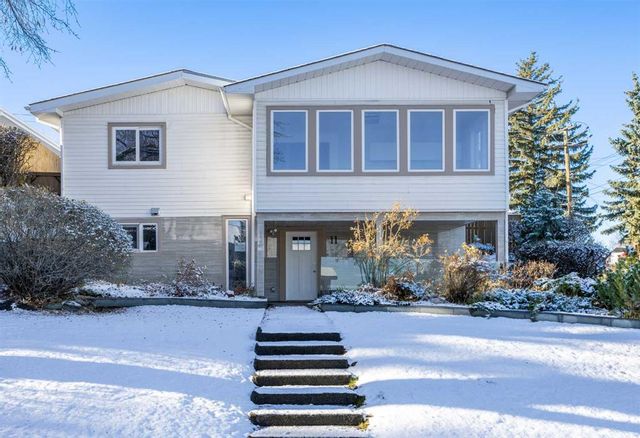
The tell for a transition community is simple and you can see it from the car: a street of 1960s bungalows where three houses have new windows, new front doors and a fresh garage, and the rest have not been touched since the original owners moved in. That is a neighbourhood mid-turnover. The renovated ones are setting a new price ceiling that the untouched ones have not caught up to yet.
You can also pick communities based on the average age of the homes – Click Here
2. Is the Land Worth More Than the Building?
This single question does more work than everything else combined.
A building depreciates from the day it is finished. Roofs, furnaces, windows, wiring, kitchens — all of it is consumable on a schedule. Land does not depreciate, is not manufactured, and in an established Calgary community cannot be added to at any price.
So the question on any property is: what fraction of this price is land?
A 1962 bungalow on a 50-foot lot in an inner community is mostly land with a depreciating shed on it. A brand-new attached townhome on the edge of the city is mostly building on a sliver of land. The first appreciates because the scarce component dominates. The second struggles because the wasting component does.
I laid out the ten-year evidence for this in why detached homes in older Calgary communities quietly outperform, and the 2026 numbers keep making the case. In August, detached was down about 1% year over year while apartment condominiums were down over 8% — same city, same month, same interest rates, completely different land content.
3. What Do Sales Actually Show?
Asking prices are opinions. Sold prices are facts. A community where eleven houses are listed at $700,000 and three have sold at $640,000 is a $640,000 community, and everyone who quotes you the $700,000 list price is quoting you a wish.
What I want to see for any community I am considering:
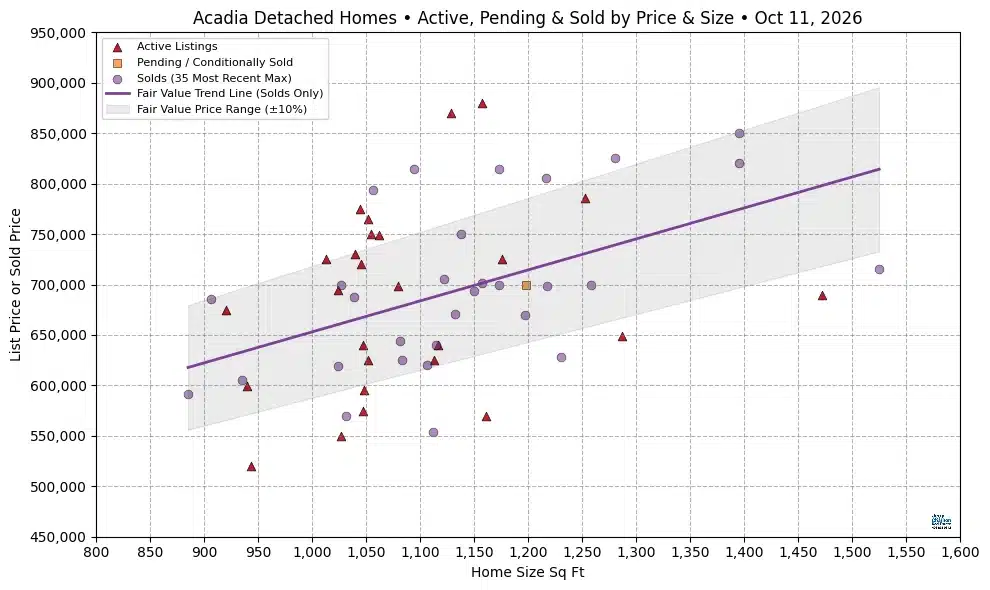
- Sold price plotted against square footage for the last 12-24 months.
- The trend line through those sales — the expected price for any given size.
- Which active listings sit below that line.
That relationship is exactly what my Deal Finder automates across more than 100 Calgary communities, daily. But you do not need my tool to think this way — you need to stop looking at averages and start looking at the price-to-size relationship inside one specific community.
A city-wide benchmark of $569,800 tells you nothing about whether a particular Acadia bungalow is a deal. Your real estate market is not the Calgary real estate market.
4. Does the Rent Math Work?
I have managed rental properties in Calgary for a long time, and I have watched a lot of investors buy something that only works if everything goes right. Everything does not go right.
The deal has to survive ordinary reality: a month of vacancy between tenants, a tenant who leaves early, an appliance replacement, an insurance increase, a year where the furnace and the hot water tank agree to fail together. If it only works at 100% occupancy with no maintenance, it does not work.
Some current context: the most recent Government of Alberta figures put Calgary’s average two-bedroom rent at $1,896, up only about 1.4% year over year. That flattening is important. Rents are no longer bailing out marginal purchases the way they did from 2021 to 2024, and the rental market has swung toward tenants. Underwrite on today’s achievable rent, not on last year’s trajectory.
5. Can I Add Value the Market Will Pay For?
Buying and waiting is a strategy. Buying and adding is a better one, because it does not depend on the market doing you a favour.
In Calgary the things that add real value are fairly specific:
- A legal secondary suite. Turns one income stream into two and widens the buyer pool at resale.
- A backyard suite. Calgary will pay up to $35,000 toward building one. A grant that covers a meaningful share of the build changes the return profile of a whole category of lots.
- Developing an undeveloped basement in a community where finished basements are the norm.
- A disciplined cosmetic renovation — the model that works in Acadia, where I analysed 96 documented flips to see what actually returned money and what did not.
What does not add value reliably: a luxury kitchen in a starter community, a pool, anything that makes your house the most expensive on the block. The ceiling of a street is real and you cannot renovate past it.
6. What Is Being Built or Approved Nearby?
Most investors check the property. Fewer check what the City has already approved three blocks away, and that information is public, free, and available 24 hours a day.
A new LRT station, a school, or a commercial node is a tailwind. Four hundred purpose-built rental units going up nearby is a headwind for your rents. A rezoning that allows the bungalows around you to become fourplexes changes your land value — usually upward, sometimes dramatically.
I wrote a walkthrough of how to find and read Calgary development permits. It takes twenty minutes and I would not buy an investment property without doing it. The current condo correction is a city-scale demonstration of what happens when people ignore the construction pipeline.
7. Would I Own This Through a Bad Decade?
The last filter is the one that has saved me the most money, and it is not analytical.
Calgary is not a smooth market. It runs on energy, migration and sentiment, and it produces genuinely difficult stretches — I have been through several since 2002. Anyone who has watched two decades of Calgary foreclosure data has seen what a bad stretch does to people who were fine on paper.
So the question is not “will this appreciate?” It is: if prices went sideways for eight years and rents did not move, could I comfortably hold this the whole time?
If yes, the downside is genuinely bounded and time is working for you. If no, you are not an investor in that property, you are a leveraged speculator hoping the market cooperates on your timetable. Almost everyone who loses money in Calgary real estate loses it by being a forced seller at the wrong moment — not by picking the wrong community.
So Where Would I Look Right Now?
Not a list of names, but a description you can apply yourself. In the current market I would be looking for:
- An established inner community, built out, no room for new supply.
- Detached, on a full-size lot — maximum land content per dollar.
- In the transition phase: visible renovation activity, but plenty of untouched original stock left.
- Priced below the community’s own price-to-size trend line.
- With a suite, a basement, or a backyard suite opportunity I can add.
- That I could carry through a bad decade without losing sleep.
Several Calgary communities fit that description today, and the ones that do are mostly not on anybody’s top-ten list — which is precisely the point. When a community makes the list, the discount is gone.
If you want to run these filters against a specific community, I will pull the sold-price-to-size data for it and send it over. Tell me the community and the property type. That is the piece most investors cannot get on their own, and it is the one that actually decides the outcome.
Jerry Charlton — eXp Realty — 403 831 0842 — Jerry@JerryCharlton.com
Frequently Asked Questions
What are the best Calgary communities to invest in?
The better question is what phase a community is in. Established inner communities in the transition phase, original owners aging out, visible renovation activity, but plenty of untouched original stock offer the best risk-adjusted entry. Communities that top published lists have usually already appreciated, which means the opportunity has passed.
Is it better to buy a detached home or a condo as a Calgary investment?
Detached, in most cases, because of land content. Established Calgary communities cannot add supply, while apartment supply is manufactured which is why August 2026 saw detached down about 1% while apartment condominiums fell over 8% in the same month under the same conditions.
How do I know if a Calgary property is underpriced?
Plot recent sold prices against square footage for that specific community, fit a trend line, and see which active listings sit below it. City-wide averages and benchmark prices cannot tell you this, the relationship only holds within a single community and property type.
Does Calgary offer grants for building a secondary suite?
Calgary’s Backyard Suite Incentive Program offers up to $35,000 toward building a backyard suite. A grant covering a meaningful share of the build materially changes the return profile of lots that can accommodate one. Cjeck with the city as their policies change like Calgary’s weather.
What will it rent for?
Rentfaster.ca charges landlords in Calgary $50 or more for a listing on the website. That makes it my goto source for Rental Market Research. Look at the properties you would be competeing with if you bought your proposed investment. The rental market changes constantly so you have to keep up with it to be a successful real estate investor. I look at what everyone else seems to be getting and how can I beat them all and stay cash flow positive.
What type of Calgary property makes the best investment?
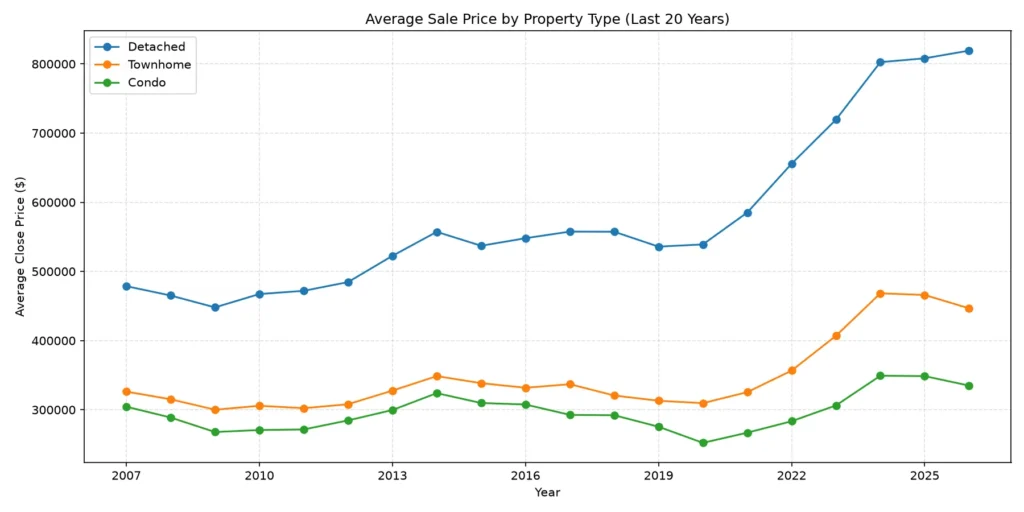
Detached Homes – no Contest! Look at the chart below for Condos, Townhomes and Detached Homes in Calgary for average prices over the past 20 years. This chart makes it crystal clear where the biggest return on investment is. Detached homes have historically been much better than money in the bank.
Looking for the Right Calgary Community to Invest In?
I’ll run the numbers on the communities on your list: prices, rents, appreciation and what’s actually selling.
No pressure, no scripts, just honest numbers.