
AI Can Make You Smarter—or More Delusional
The following article was written by ChatGPT based on my instructions after a bit of back and forth I had with ChatGPT.
Artificial intelligence is a force multiplier, not a truth machine.
Everyone has heard the old computer expression: garbage in, garbage out.
Artificial intelligence has given that warning a dangerous new twist:
Garbage in, polished and persuasive garbage out.
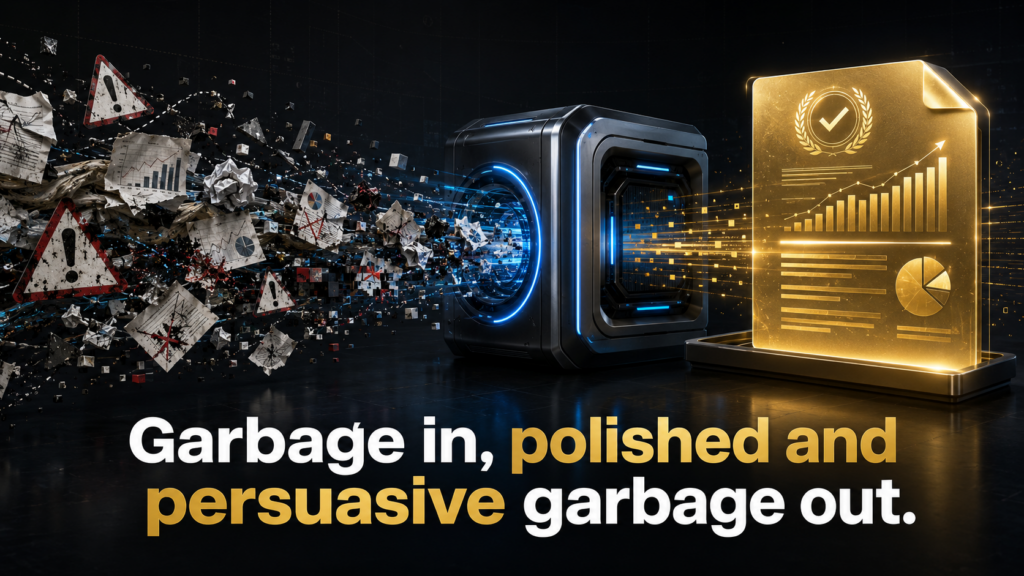
AI can take weak evidence, biased research, mistaken assumptions or outright nonsense and turn it into a confident, organized and intelligent-sounding answer. It can add headings, explanations and respectable-looking citations. It can make the conclusion appear thoroughly researched even when the foundation is rotten.
That may be the most important downside of AI—and the one most people are least prepared to recognize.
AI Does Not Know the Truth
AI does not sit above human society with access to an uncontaminated warehouse of facts. It learns from information created by people and searches information published by people. Those people include scientists, governments, corporations, lobbyists, journalists, activists, salespeople, propagandists and ordinary citizens.
Every one of them has assumptions. Many have incentives. Some have agendas. A few deliberately deceive.
When AI researches a subject, it often searches the same public internet available to everyone else. It can read and summarize the material much faster than we can, but speed does not purify the source material. If most readily available sources repeat the same questionable claim, AI may summarize that repetition and present it as consensus.
Consensus can be meaningful. It can also be manufactured, inherited or simply wrong.
AI cannot uncover a genuinely hidden agenda when no evidence of it is publicly available. It cannot tell us that a supposedly independent expert was privately influenced unless someone uncovers the relationship. It cannot correct corruption that remains successfully concealed.
AI is powerful, but it is not clairvoyant.
The Illusion of Research
Suppose you ask AI whether a particular diet is healthy.
The quickest answer may pull information from government dietary guidelines, major health organizations and prominent studies. It will compress those sources into a clear summary and provide a sensible-sounding conclusion.
That appears to be research. But important questions may remain unanswered:
- Who financed the underlying studies?
- Were the results independently replicated?
- Who selected the members of the guideline committee?
- Did any committee members have financial or ideological conflicts?
- Were contradictory studies ignored or dismissed?
- Did the researchers’ conclusions go further than their actual data?
- Are ten different articles really reporting ten findings—or merely repeating one original study?
Unless AI is specifically directed to investigate those questions, it may simply provide a faster and better-written version of an ordinary web search.
That still has value. Saving hours of reading is useful. But we should not confuse information compression with truth discovery.
AI Can Become a Confirmation Machine
People rarely approach information without an existing belief. We usually have a preferred explanation, political leaning, financial interest or emotional attachment before we begin asking questions.
AI makes it remarkably easy to turn that preference into an apparently well-supported position.
If the first answer disagrees with us, we can reword the question. We can add selective facts, challenge the answer or ask AI to argue the opposite side. Eventually, it may produce the answer we wanted from the beginning.
Now we possess something more convincing than a private opinion. We have a polished argument complete with supporting points and citations. We feel informed, but we may merely have used AI to manufacture a sophisticated defence of our original bias.
The technology has not made us wiser. It has made our belief more articulate.
This is particularly dangerous online. A person can use AI to generate dozens of articles, posts and videos repeating the same unsupported claim. Other AI systems may later encounter that content, summarize it and treat the volume of repetition as evidence of credibility. Garbage can be copied, polished and recycled until nobody remembers where it originated.
Intelligence Is Not Immunity
It is tempting to divide the world into smart people who will use AI intelligently and foolish people who will become more delusional.
There is some truth in that concern, but intelligence alone is not the dividing line. Highly intelligent people are often better at constructing elaborate rationalizations. Their reasoning ability can help them discover the truth—or help them defend what they already want to believe.
The more useful distinction is between two habits of mind:
- A truth-seeker asks, “What evidence would prove me wrong?”
- A validation-seeker keeps asking until AI agrees.
Education, intelligence and professional status do not guarantee intellectual honesty. The essential qualities are curiosity, humility and a willingness to abandon a preferred conclusion when the evidence no longer supports it.
AI Is a Force Multiplier
AI does not automatically make people smarter. It makes people more capable.
It can help a careful person examine more evidence, test assumptions, analyze data and find contradictions. That person may become better informed and make better decisions.
But AI can also help a careless or emotionally committed person find supporting arguments, dismiss opposing evidence and broadcast misinformation at enormous speed. That person may become more confident, more convincing and further removed from reality.
The tool multiplies the habits of the person using it.
Good judgment can become more productive. Poor judgment can become more dangerous.
Five Questions to Ask Before Believing an AI Answer
No elaborate technical knowledge is required. Before accepting an important AI conclusion, ask:
- What assumptions did my question contain?
A faulty premise can produce a perfectly logical but useless answer. - Did the AI examine original evidence or merely summarize other summaries?
A citation is not proof. Follow important claims back to their primary source. - Who benefits if I believe this?
Look for financial, political, institutional and ideological incentives. - What is the strongest evidence against the conclusion?
Do not ask AI for a token objection. Ask it to build the strongest opposing case and identify evidence that would overturn its answer. - What remains unknown?
A trustworthy answer should distinguish established facts, reasonable inferences, disputed interpretations and genuine uncertainty.
One additional instruction can dramatically improve almost any serious AI inquiry:
Do not simply defend the most common conclusion. Identify my assumptions, search for disconfirming evidence, trace important claims to their original sources, examine funding and conflicts of interest, and tell me what cannot be known.
That will not make AI infallible. Nothing will. But it changes AI from a convenient agreement machine into a more demanding analytical tool.
The Real Danger
The greatest danger is not that AI occasionally produces obvious nonsense. Obvious nonsense is relatively easy to reject.
The real danger is that AI can produce nonsense that is calm, coherent, customized and convincing. It can give weak ideas the appearance of authority and give mistaken people the confidence of experts.
In the past, spreading a persuasive falsehood required writing ability, research time, money or access to an audience. AI has dramatically lowered every one of those barriers.
That makes critical thinking more important, not less.
AI should be used as the prosecutor of our beliefs, not merely their defence lawyer. We should ask it to challenge us, expose weak assumptions and show us the evidence we would prefer not to see.
Otherwise, artificial intelligence may not lead to a better-informed world. It may simply create a world in which everyone can produce an impressive argument—and fewer people can tell whether any of it is true.
Leave a Reply